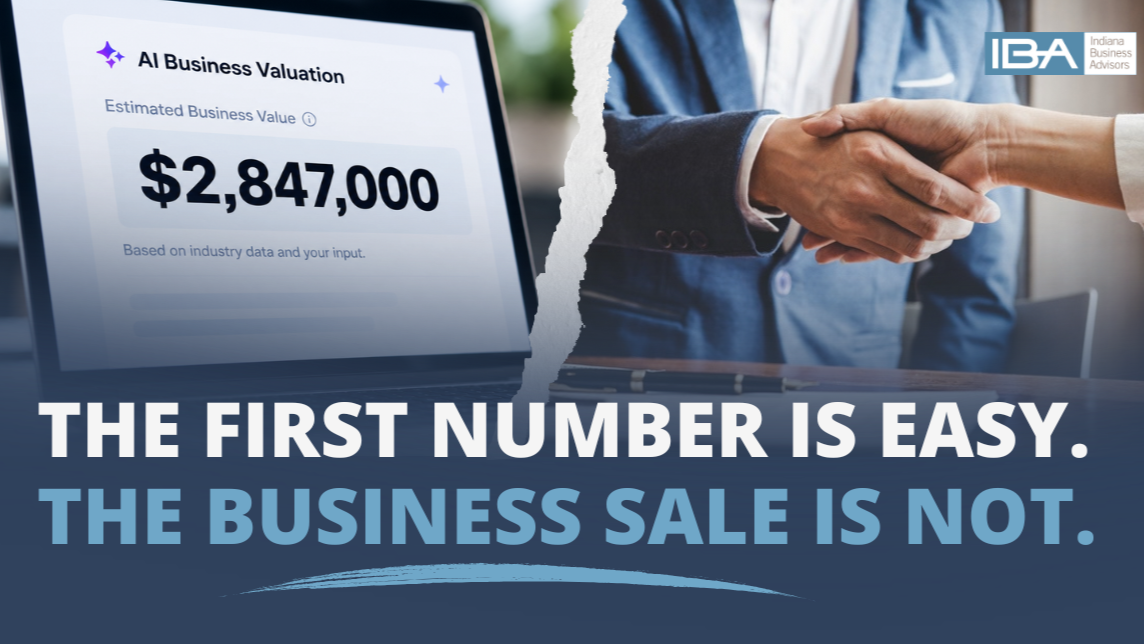
AI valuations will keep showing up. That is not the problem. Treating them like a closeable price is.
A seller walks in with a screenshot or a copy-and-pasted email output. A buyer walks in with a different one. Both numbers arrived in seconds. Both sound like analysis. Neither one asked what it would cost to keep the business competitive after the owner is gone.
The business sale community is uneasy about that, and I understand why. An unadjusted multiple delivered with certainty will wreck an engagement. It will also waste six months of a buyer’s time. What I don’t understand is pretending this wasn’t going to happen.
Owners have been asking “what is my business worth?” for as long as I have been in this work. They used to ask a golf partner, a neighbor, or a rule of thumb they heard at a conference. Now they ask a machine. Buyers do the same thing on the other side of the table. Of course they do. The question is free. The answer is instant. And the first number in the room has always had power.
Easy and almost free is why it spread
BizEquity was one of the first online platforms most of us ran into. All in BV cringed. Some of us (me) even gave it a whirl. A cheap number in an owner’s hands can create a difficult value anchor when your job is to reach a price a buyer and a bank will accept. The platform spread not because it was a certified appraisal. It spread because it was easy and, to the owner, as close to free as you can get. The advisor paid for the platform seat. The client got a report in minutes.
RIAs, insurance producers, and bankers used it because it opened conversations they were not having: buy-sell funding, key-person coverage, estate equalization, and “what does this company need to be worth for you to leave?” The number opened the conversation. The advisor was supposed to explain what the number meant, and what it did not.
That is the part worth remembering. BizEquity had a process and an implied lane: planning, not a wired purchase price. What owners have now is the same impulse with the guardrails pulled off. Anyone can type “I own a [industry] company, we do $X in sales and $Y in profit, what is it worth?” and get a confident answer built on unadjusted earnings and a national multiple.
Baton Market and SMB dot co, among many others, are running a version of the same playbook. They leverage public data and algorithms and package it as “your business value.” Others will follow. These tools will keep competing on speed and price, not on whether the number survives a buyer’s diligence or a lender’s underwriting. ChatGPT is the extreme case: no firm, no workflow, no one sitting next to the output.
The gift is that they asked
I would rather an owner arrive with a wrong number than arrive having never thought about value at all. The first is a conversation. The second is a surprise at retirement age.
A near-free first number is how exit planning got into rooms it never reached, no matter how crude or inaccurate. If your client (or you) already asked a model what the company is worth, you did not ruin the process. You started it earlier than most owners ever do.
The mistake is failing to stress-test the AI result.
It is becoming a prompt fight
This is no longer just the owner versus the advisor. It is the seller’s model versus the buyer’s model. Each side feeds the machine a different story. Each side gets a number that feels earned because the prompt got longer. I get to referee.
The seller includes growth potential and last year’s profit. The buyer includes concentration, owner hours, and “what should I offer?” The sharper prompt wins the argument. It does not get the deal done.
A business sale is not an abstract battle between two counterparties. It is a bank that will lend, a company that still works under new ownership, a price that holds up after someone has looked under the hood, and, finally, a buyer who can close.
And the prompts will get better. The answers will look better. Owners already upload real financials. Buyers will load CIMs, comps, copy-and-pastes of Reddit threads, X takes, and “download now” risk lists from the gurus peddling courses. The next wave of tools will wrap a nicer interface around the same incomplete sale comps the industry already uses. Unlike residential real estate, there is no MLS for Main Street deals. That is kind of an improvement over an AI guessing a multiple. It is not a complete record of what sold. Most deals never make it into those files, and what does rarely includes the terms that made the price possible: structure, working capital, whether real estate was in the deal. The output will sound more official. We cannot ignore that. If you are waiting for the answers to stay sloppy so you can dismiss them, you will wait through the rest of your career.
A cleaner first number is still a first number.
What the chat did not ask
A seller sent me the valuation his AI produced. The earnings looked fine on the page he gave the model. The model never asked what it would cost to stay competitive: the capital expenditures and technology investments the next owner would have to make. Those checks were not optional commentary. They were cash a new owner would have to fund to keep the business in the game.
I used his output as my input. I asked the material questions that were innocently omitted. It was a different business once those questions were in the model. Same company. Different valuation. The model did not change. The person asking did.
That is the pattern. The typical owner prompt is some version of “what is my business worth?” plus revenue and profit. What rarely gets included is the difference between tax profit and recast earnings, whether the company runs without the owner, and whether a bank can finance the price, including the practical ceiling many SBA structures (10% equity, 10% seller note, 80% bank) put on what a buyer can pay. Those are not insider tricks. They are the questions a buyer asks after the screenshot.
What to do with the AI output?
Owners: ask. Then assume the first answer is incomplete. Add what it omitted. Ask again for a range and the assumptions. Bring that chat output to your CPA, your attorney, or the advisor who already knows the company before you spend the number. A smarter chatbot still does not close your deal.
Deal advisors: don’t mock the chat output, and don’t rubber-stamp it. If you sneer, the owner hides the next one. If you bless it, you own the value anchor. Say, “Good. Now let’s see what you didn’t know to ask.” You are not competing with the chatbot. You are the person who can tell where the chatbot stopped analyzing and started agreeing with whoever typed the question.
When the number has to become a deal, that is the call to the person whose job is transfer, structure, financing, and diligence.
The business valuation goal has not changed
BizEquity industrialized a planning number that helped advisors start useful conversations. The new wave is doing the same thing faster and more cost-effectively, with AI on the label. But a planning estimate and a closeable price are different products. A closeable price has to reflect recast earnings, transferability, deal structure, financing, and the risks a buyer will uncover during diligence.
We were never paid for being the only calculator in town. We were paid to make a number survivable for two parties risking it all. The first number is easy now. That is fine. Use it. Just don’t confuse it with how deals get done.
First published on LinkedIn.