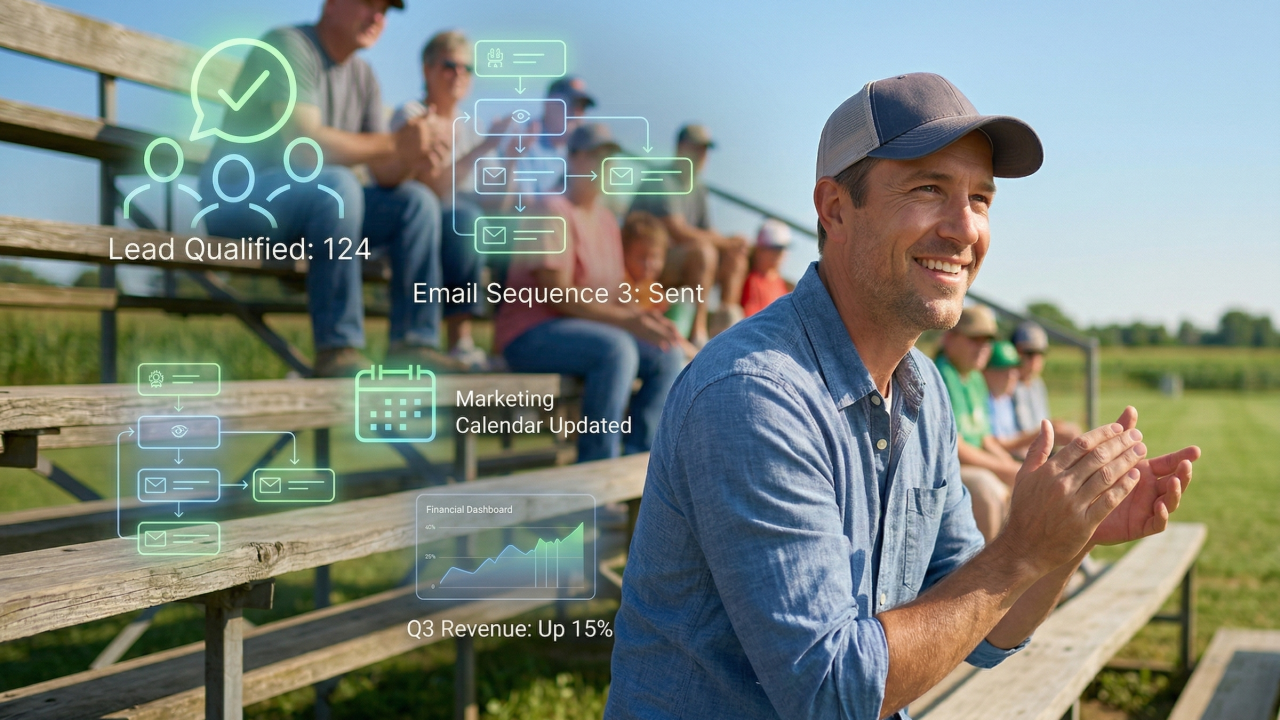
A business owner in rural America is living exactly as they envisioned when starting their business. They are at their kid’s baseball game on a Wednesday afternoon. They are fishing. They are at the farmers market. They are involved in their community in a way that their urban counterparts abandoned years ago for scale, staff, and a social media-worthy lifestyle.
While they are occupied with that, the business is on hold. Leads are not being followed up on. Awareness campaigns are not going out. The pipeline remains idle. The customer who called this morning is waiting. This is the lifestyle business in its natural state: profitable when the owner is present, quiet when they are not. A single point of failure disguised as freedom.
Now rewind the scene. Same owner. Same Wednesday afternoon. Same baseball game. Except this time, the business isn’t pausing. An AI agent is qualifying the morning’s inbound leads. Another is sending the follow-up sequence to the three prospects who went quiet last week. The content calendar is rolling out. QuickBooks is being monitored. The customer who called is getting a reply.
The owner did not hire anyone. Did not build a management team. Did not sacrifice the lifestyle. The agents are doing what only the owner used to be able to do, continuously, without vacation, without distraction, without the variability that made the lifestyle business fragile in the first place.
This is the question nobody in business is asking: Can AI save the lifestyle business?
I believe the answer is yes. But the more precise answer is that the lifestyle business did not need to be saved from the outside. It needed the risk concentrated inside it to be distributed. For the first time, it can be.
Everyone is focused on what AI will take from us. I’m curious about what AI will provide to small businesses.
What “Lifestyle Business” Actually Means, and How a Neutral Term Became an Insult
The term has no negative origins. Economists originally used it simply to distinguish between the “lifestyle” entrepreneur, who primarily builds for nonmonetary benefits like autonomy and flexibility, and the “gazelle” entrepreneur, who pursues growth at scale.
Over time, as tech businesses became the dominant cultural standard for what a real business looks like, a neutral distinction turned into a hierarchy. Lifestyle businesses didn’t just differ from growth businesses. They became seen as lesser.
To be fair to the critics, there was a genuine operational issue hidden within the cultural judgment, and the following argument will separate the two matters.
The legitimate critique: lifestyle businesses were often fragile. Owner-dependent, under-documented, relationship-concentrated, and essentially untransferable. The business existed in the owner’s head and contact list. When the owner stepped away, the business paused.
The illegitimate critique: that a business built to support the owner’s life is somehow less serious, less legitimate, or less worthy of respect and a future exit. Lifestyle businesses depend on the owner’s skills, personality, energy, and contacts. Often, their founders create them to exercise personal talent, achieve a flexible schedule, work with family members, remain in a desired geography, or simply to express themselves.
Read that list again: talent, flexibility, family, geography, self-expression. These are not disqualifying flaws. They are the things most people aim to build their lives around. The investor community saw them as red flags. The rest of the world sees them as goals.
The term did not start as an insult. It became one when one ecosystem’s financial constraints got mistaken for a universal standard of business legitimacy. It never was.
The Real Problem Was Never Lifestyle. It Was Concentrated Risk.
The honest version of the critique, stripped of cultural bias and examined on its structural merits.
The lifestyle business wasn’t fragile because it was small. It wasn’t fragile because the owner valued Wednesdays more than multiples. It was fragile because it was a single point of failure disguised as a business. Everything of value was concentrated in one person: the relationships, the institutional knowledge, the operational execution, the reputation, the judgment, the network.
When the owner was present, the business operated. When they were absent, whether due to choice, circumstance, illness, burnout, or simply the desire to live the life they built the business to support, the business paused, declined, or stopped functioning in ways that mattered to a future buyer.
The goal was the lifestyle. The vulnerability was the focus. For decades, the only answer was to sacrifice one to achieve the other: hire staff, build systems, delegate constantly, and spend years working on the business instead of in the life you built it for.
That was the false choice built into the lifestyle business model. You could have the lifestyle or a transferable business, but rarely both.
AI agents dissolve that false choice. Not by eliminating the lifestyle. Not by turning the business into something it was never meant to be. But by distributing the concentration that made the model fragile.
The owner’s relationships, judgment, and reputation remain crucial, and they should. However, the operational infrastructure, customer touchpoints, business development rhythm, financial monitoring, and marketing presence, all of which previously depended on the owner’s constant personal attention, can now be managed through workflows that operate independently of the owner’s schedule, health, or presence on any day.
That is risk distribution in the most literal sense. And it changes everything downstream.
Something Is Happening That Strengthens the Argument
The lifestyle business conversation is taking place against a backdrop that most analysts have not yet connected to it.
After a decade of population loss, rural America is growing again. Indiana tells the story clearly. From 2010 to 2020, Indiana’s 23 rural counties declined by an average of more than 1,000 residents per year as a group. In the wake of the pandemic, that reversed: rural Indiana has grown by more than 1,500 residents per year in 2023 and 2024. 73 of Indiana’s 92 counties added population in 2024, the largest number to show an annual increase since 1997. The national pattern mirrors it: net domestic migration in rural counties nationally flipped from a net outflow of roughly 100,000 people from 2017 to 2020 to a net inflow of 670,000 people from 2021 to 2024.
What held people back from making this move for decades was income. Fewer jobs, fewer professional networks, less access to clients and capital. Remote work began loosening that constraint. AI is about to finish the job. The agent stack does not care where the owner is located. The playing field between rural and urban business owners is flattening in ways it never has before.
When an $85,000 analyst role disappears not because of a recession but because a machine does it better, the displaced worker does not always wait for the next corporate opening. Many start something, or buy something. And increasingly, freed from geographic employment constraints, they are heading somewhere they actually want to live. Our most recent Butler ETA conference confirms this.
Business schools are already registering the shift. Seventeen percent of Harvard Business School’s 2025 graduates said they plan to start their own business, the highest share on record, up from 8% in 2021. The solo founder model is not a fringe phenomenon waiting to happen. From 2019 to mid-2025, the share of new startups with a solo founder rose from 23.7% to 36.3%, the first time in over 50 years of startup history that more than one in three startups have a solo founder.
The lifestyle business owner of 2026 does not look like the one of 2010. They are more likely to be digitally fluent, AI-enabled, location-independent, and building something that works without them in ways their predecessors never could. The model is the same. The tools are unrecognizable.
AI Agents: The Infrastructure That Changes Everything
The legitimate critique of lifestyle businesses was always structural: the owner could not step away because there was nothing to step away from. No system. No process ran without them. No infrastructure operated independently of their availability on any given Tuesday.
AI agents change that equation.
Lead generation and qualification run continuously, not in bursts when the owner has bandwidth. Customer follow-up executes on schedule, not when the owner remembers. Content maintains a consistent cadence, not going dark for weeks at a time. Bookkeeping anomaly flagging happens in real time, not discovered at tax time. Appointment scheduling and pipeline management run without manual intervention.
Each of those functions was once reliant on the owner’s time, attention, and availability. Now, they can be handled by an agent who works consistently, without vacations or burnout, and continues working even when the owner is at a baseball game.
The business does not pause when the owner does. That is new. That is the change.
There is also a compounding obsolescence problem that lifestyle business owners have not yet fully priced. Traditional obsolescence accumulates quietly: outdated processes, manual workflows, tribal knowledge that lives only in the owner’s head. Each erodes buyer confidence over time. The owner who has not deployed AI agents is now carrying a new category of discount that did not exist three years ago, layered on top of the traditional owner-dependency discount the lifestyle business already absorbed. That is a compounding problem, and it begins affecting buyer perception well before it shows up in a transaction price.
The New Valuation Calculus
Business value is fundamentally earnings multiplied by a multiple. The lifestyle business has always absorbed a double hit on both sides of that equation. Operational obsolescence erodes earnings first, quietly, through aging processes and manual workflows that cost more than they should. Then it compresses the multiple when buyers price the risk that those earnings will not survive the ownership transition.
AI deployment introduces three distinct valuation dynamics.
The adoption premium. A lifestyle business with an effective agent stack will command a wider buyer pool and a stronger negotiating position because the risk profile is fundamentally different. The operation is transferable. Institutional knowledge lives in documented workflows rather than one person’s memory. Buyers pay more for businesses that do not depend on the seller.
The obsolescence penalty. A lifestyle business without AI infrastructure now carries a discount that builds on the traditional owner-dependency discount it already absorbs. A buyer looks at the business and asks: my competitor will run this operation with an agent stack that handles all of this faster and cheaper. What am I actually buying here? That question suppresses price, lengthens time on market, and narrows the buyer pool.
The replication discount. This is the most uncomfortable of the three. If a buyer with AI fluency can understand a lifestyle business’s model, customer base, geography, and revenue streams, and build a competing version using AI agents in 90 days for a fraction of the acquisition cost, the acquisition premium compresses toward the value of the non-replicable assets only: relationships, reputation, and the time it would take to build those organically. AI does not replicate those things. But it does make the operating model replicable, which means what a buyer is actually paying for has become clearer.
There is currently no data set that rigorously compares AI-enabled and non-AI-enabled lifestyle business transactions at scale. However, that data will be available within five years. Advisors who start tracking it now, asking sellers about agent infrastructure during intake and noting AI adoption in deal documentation, will lead the conversation when the data aligns with their intuition. The transactions currently underway are the foundation of that data set.
The Buyer the Lifestyle Business Never Had
The key downstream effect of AI-powered lifestyle businesses isn’t what it offers sellers. It’s how it impacts buyers, especially those who have traditionally avoided lifestyle businesses due to concentrated risk.
The traditional lifestyle business buyer was a limited type: someone with industry knowledge, local relationships, and confidence in their ability to step into the seller’s shoes without losing the customers that came with them. That is a small pool. It was small by necessity because the risk was personal and immediate.
When a lifestyle business owner has implemented an agent stack that operates the operational and business development processes independently of their presence, the buyer is no longer just purchasing a business. They are buying a system with a business embedded in it. The owner’s departure signifies a leadership transition, not a void. The due diligence questions shift from what occurs when the owner leaves to how effectively this system functions without them. These are questions that can be answered, whereas the initial ones rarely could.
Three buyer profiles emerge that essentially did not exist before.
The remote-first buyer: someone seeking income and lifestyle without any geographic ties to the seller’s location. They can run an AI-enabled business from anywhere, which ties into the rural migration argument.
The displaced white-collar professional: someone with domain knowledge, organizational skills, and AI fluency, but no tolerance for buying a business that depends entirely on a relationship network they cannot inherit. Provide them with documented workflows and agent infrastructure, and that objection disappears. They know how to operate systems. They are looking for a system worth operating.
The first-time buyer who never would have considered a lifestyle business before. The owner-dependency risk was a dealbreaker. AI infrastructure makes the transition less intimidating: there’s something concrete to learn and manage, not just a personality to replace and a network to hope survives.
AI-enabled lifestyle businesses are not only easier to sell. They are also accessible to a new class of buyers: qualified, motivated, and previously excluded by the very risk that AI now mitigates.
The Answer to the Question Nobody Was Asking
Return to the scene from the opening. The owner at the baseball game. The business running without them.
The lifestyle business always had the right model. The owner who built something profitable, personally meaningful, community-rooted, and aligned with how they wanted to live was not making a lesser choice than the founder chasing venture capital and dreaming of a liquidity event. They were making an earlier choice, one that the tools of the era could not fully support.
The tools just arrived.
AI agents do not save the lifestyle business by transforming it into something it was never intended to be. They save it by addressing the specific structural issue that made it fragile: the concentration of all valuable assets in a single human, and the resulting vulnerability for buyers, lenders, and owners when life does not align with the business schedule.
The seller who deploys agents now is not just protecting their lifestyle. They are expanding their buyer pool, reducing their obsolescence risk, and building something a buyer can inherit instead of becoming dependent on.
The lifestyle business didn’t need a new model. It needed its risk spread out. Now, it can be.
First published on LinkedIn.